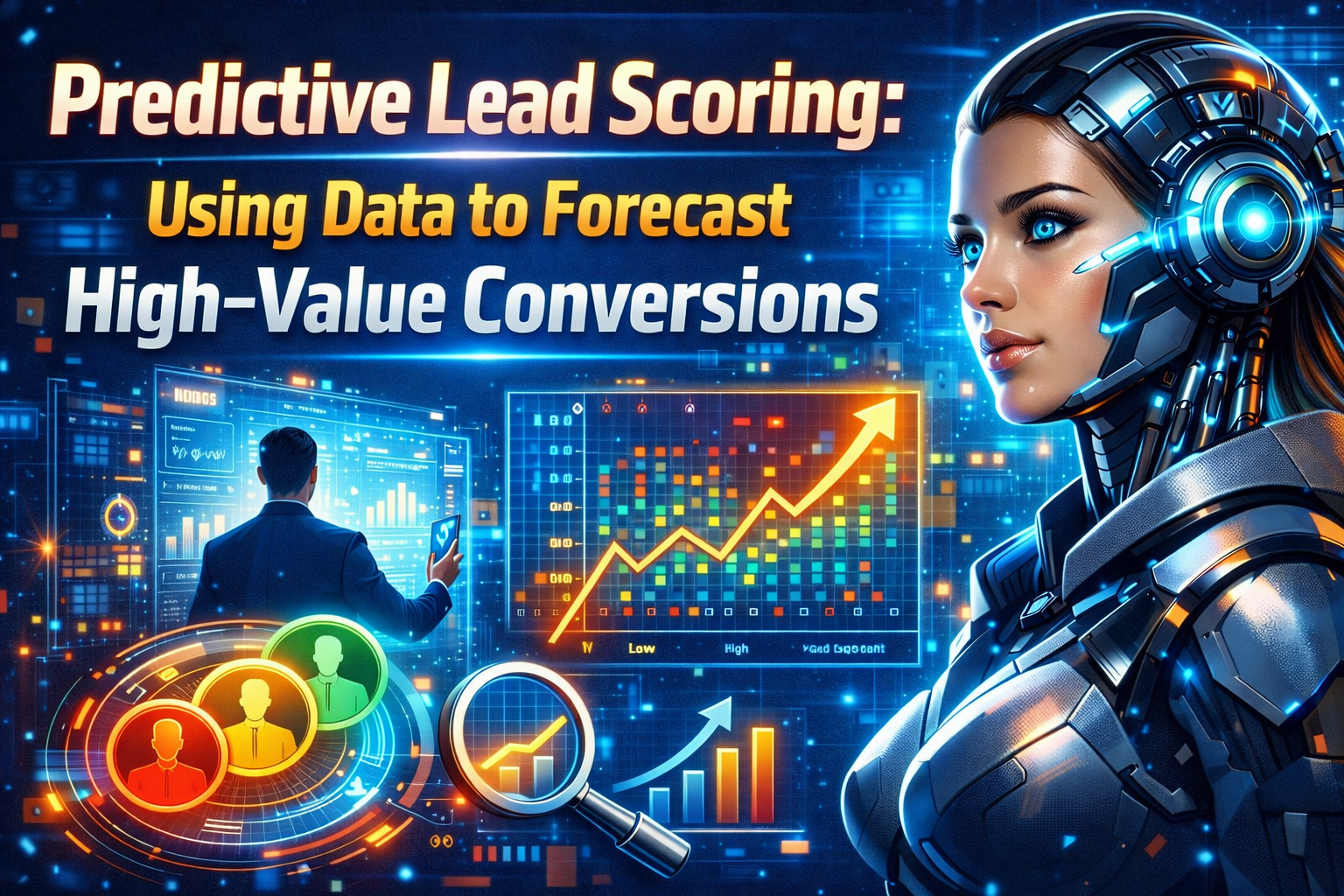
Learn how Predictive Lead Scoring uses machine learning and historical data to forecast high-value conversions, optimize sales efficiency, and align marketing teams in 2026.
Table of Contents
In the high-stakes world of modern B2B sales, time is the only non-renewable resource. Every minute a sales representative spends chasing a prospect who was never going to buy is a minute lost on a prospect who was ready to close. For decades, marketing and sales teams have struggled to filter the noise from the signal, often relying on gut feelings or rudimentary point systems to prioritize their outreach. However, as data availability explodes and machine learning becomes accessible, a new standard has emerged. Predictive Lead Scoring is no longer just a buzzword for tech giants; it is the fundamental engine driving efficient revenue growth in 2026.
The era of “spray and pray” marketing is over. Today’s most successful organizations are using sophisticated algorithms to mathematically determine which leads are worth their time. By analyzing thousands of data points—from website behavior to firmographic details—Predictive Lead Scoring transforms the chaotic sales funnel into a scientifically prioritized pipeline. This guide will explore exactly how this technology works, why it is superior to traditional methods, and how you can implement it to forecast high-value conversions with precision.
The Evolution: From Gut Feeling to Data Science
To appreciate the power of Predictive Lead Scoring, we must first look at what came before it. Traditionally, lead scoring was a manual, rules-based exercise. Marketing and Sales leaders would sit in a room and arbitrarily assign points to certain actions. “If they download a whitepaper, give them 10 points. If they are a VP, give them 20 points.” While better than nothing, this approach was flawed because it was based on human assumption, not empirical evidence.
It turns out that what we think makes a good lead often differs from reality. Perhaps VPs are great targets, but in your specific industry, it’s actually the Directors of Operations who sign the checks. A rules-based system might miss this nuance entirely. Predictive Lead Scoring eliminates this bias. instead of relying on human guesswork, it ingests your historical CRM data—looking at every deal you have ever won and lost—to identify the hidden patterns that actually correlate with a sale. It doesn’t guess; it calculates probability based on proven past behaviors.
How The Engine Works: Inside the Black Box
At its core, Predictive Lead Scoring utilizes machine learning models to compare current prospects against your historical customer base. It asks a simple but computationally complex question: “How similar is this new lead to the leads that have successfully converted in the past?”
To answer this, the model analyzes two primary categories of data:
1. Explicit Data (Who They Are)
This includes firmographic and demographic information. The Predictive Lead Scoring algorithm looks at company size, industry, revenue, location, and the lead’s job title. It might discover, for example, that your product has a 40% higher close rate with manufacturing companies in the Midwest with revenue between $50M and $100M.
2. Implicit Data (What They Do)
This is behavioral data. It tracks digital body language. Did the lead visit the pricing page? Did they open three consecutive emails? Did they attend a webinar? Predictive Lead Scoring weighs these actions not by arbitrary points, but by how frequently these specific actions appeared in past winning deals. If 90% of your closed deals involved a prospect reading a specific case study, the model learns that this action is a high-intent signal.
By combining these explicit and implicit signals, Predictive Lead Scoring generates a numerical value—usually between 0 and 100—that represents the statistical likelihood of that lead becoming a customer.
The Strategic Benefits of Adopting Prediction
Why are companies rushing to implement this? The benefits extend far beyond just “better organization.” Implementing Predictive Lead Scoring fundamentally changes the economics of your sales team.
Increased Sales Efficiency
When reps wake up to a prioritized list of leads, they stop wasting time on “tire kickers.” They focus their energy on the top 20% of leads that generate 80% of the revenue. This laser focus inevitably leads to shorter sales cycles and higher conversion rates.
Marketing and Sales Alignment
The eternal war between Sales (“These leads are weak!”) and Marketing (“You aren’t calling them!”) is often resolved by data. When both teams agree on the mathematical definition of a “good lead” provided by Predictive Lead Scoring, the subjective finger-pointing stops. Marketing knows exactly which channels are bringing in high-scoring leads, and Sales trusts the quality of the leads handed to them.
Churn Reduction
Interestingly, Predictive Lead Scoring isn’t just for acquiring new customers; it can forecast retention. The same algorithms can analyze current customers to predict which ones are “high-value” in the long term and which are likely to churn, allowing Customer Success teams to intervene proactively.
Implementing Your Scoring Model: A Step-by-Step Guide
Adopting Predictive Lead Scoring is a journey that involves data hygiene, technology selection, and cultural change. Here is how to navigate the implementation.
Step 1: Audit and Clean Your Data
Algorithms are only as good as the data they are fed. If your CRM is full of duplicate records, missing fields, or outdated contact info, your Predictive Lead Scoring model will fail. Before you buy any software, invest time in data enrichment. Ensure you have clean historical data regarding wins, losses, and deal sizes. The model needs a clear picture of what “success” looks like to recognize it in new leads.
Step 2: Define Your Ideal Customer Profile (ICP)
While the AI does the heavy lifting, it needs human guidance on strategic direction. You must define your Ideal Customer Profile. Are you pivoting to enterprise clients? Are you focusing on a new vertical? You can tune your Predictive Lead Scoring parameters to favor these strategic targets, ensuring the model doesn’t just optimize for what you sold yesterday, but what you want to sell tomorrow.
Step 3: Choose the Right Tooling
In 2026, most advanced CRMs have built-in predictive capabilities. However, standalone tools often offer deeper granularity. When selecting a vendor for Predictive Lead Scoring, ask about their data sources. do they only use your internal data, or do they enrich your profiles with third-party intent data from the open web? The best models use a hybrid approach, combining your first-party data with broader market signals.
Step 4: The Feedback Loop
A model is not a “set it and forget it” tool. It requires a feedback loop. When a sales rep interacts with a lead that had a high score but turned out to be a poor fit, they must log that reason in the CRM. Was the budget too low? Was the timing off? This feedback trains the Predictive Lead Scoring system to be smarter next time. Without human feedback, the model cannot adjust to changing market conditions.
Common Pitfalls to Avoid
Despite its power, Predictive Lead Scoring can backfire if mismanaged. One common pitfall is the “Self-Fulfilling Prophecy.” If sales reps only call high-scoring leads, naturally, only high-scoring leads will close. This blinds the organization to potential opportunities in lower-scoring segments that might be viable if approached differently. It is crucial to occasionally test “low score” leads to validate if the model is still accurate or if it is ignoring a potentially lucrative market segment.
Another challenge is the “Black Box” nature of AI. Salespeople are skeptical by nature. If the system tells them to call Company X but doesn’t say why, they may ignore it. Modern Predictive Lead Scoring platforms address this by providing “explainability”—showing the rep the top three reasons why a lead scored high (e.g., “Company expanded team by 20%” or “Visited pricing page twice”).
The Future Landscape of Lead Scoring
As we look toward the future, Predictive Lead Scoring is evolving into “Prescriptive Scoring.” Instead of just telling you who to call, the systems of tomorrow will tell you what to say and when to say it. We are seeing the convergence of scoring models with generative AI agents.
Imagine a system where Predictive Lead Scoring identifies a high-value prospect, and an autonomous agent immediately drafts a personalized email based on the very signals that triggered the high score. If the score was driven by a recent merger announcement, the outreach email will reference that merger. This seamless integration of analysis and action is the next frontier.
Furthermore, real-time scoring is becoming the norm. In the past, scores might update overnight. Now, Predictive Lead Scoring happens in milliseconds. A prospect interacts with a chatbot on your site, their score spikes instantly, and a notification is pushed to a sales rep’s mobile device while the prospect is still on the page.
Conclusion: Data as the Competitive Advantage
The divide between high-performing sales organizations and the rest is widening, and the wedge driving them apart is data maturity. Companies that continue to rely on intuition will find themselves outmaneuvered by competitors who use Predictive Lead Scoring to mathematically optimize their resource allocation.
Implementing this technology is about more than just software; it is about cultivating a culture that trusts data. It requires the discipline to maintain clean records, the agility to adapt to algorithmic insights, and the wisdom to know when to let the machine lead. By effectively leveraging Predictive Lead Scoring, you turn your CRM from a passive repository of names into an active, intelligent radar system that forecasts—and captures—high-value conversions with unprecedented accuracy.
